It wasn’t long ago that the idea of “printing” a physical object sounded like something straight out of a Star Trek episode. But today, in workshops across Dhaka and design studios in Chittagong, that sci-fi dream is a daily reality.
If you’ve ever wondered how a digital file on your screen transforms into a solid object you can hold in your hand, you’re in the right place. Let’s pull back the curtain on the magic of 3D printing (formally known as Additive Manufacturing) and see how it’s revolutionizing how we make things in Bangladesh.
Step 1: The Digital Dream (3D Modeling)
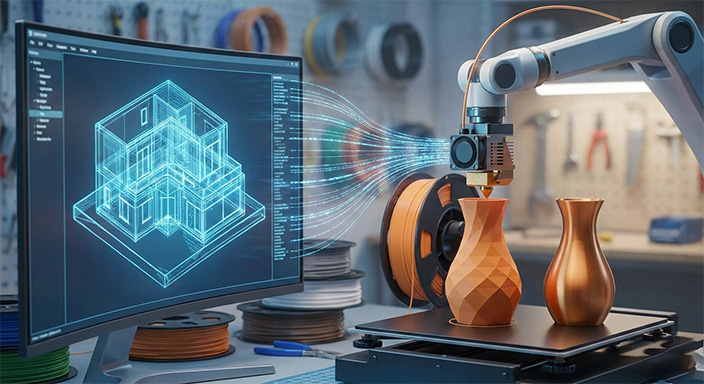
Every 3D print begins in the virtual world. You can’t print a physical object without a digital “blueprint.” This is created using CAD (Computer-Aided Design) software.
For Beginners: Tools like Tinkercad or Selva are great starting points.
For Pros: Fusion 360, SolidWorks, or Blender allow for intricate engineering and artistic details.
Once the design is finished, it is exported as an STL file. Think of an STL file as the “PDF” of the 3D printing world—it describes the surface geometry of your object so the printer can understand the shape.
Step 2: The Bridge (Slicing the Model)
A 3D printer isn’t actually “smart” enough to look at a 3D shape and know what to do. It needs step-by-step instructions. This is where Slicing Software (like Cura or PrusaSlicer) comes in.
The slicer takes your 3D model and literally “slices” it into hundreds or thousands of horizontal layers. It then generates G-Code—a language of coordinates that tells the printer:
Where to move the nozzle.
How fast to go.
What temperature to maintain.
How much material to extrude.
Step 3: The Physical Reality (The Printing Process)
While there are many types of 3D printing, the most common one you’ll find in Bangladesh is FDM (Fused Deposition Modeling). Here’s the layer-by-layer breakdown:
Heating Up: The printer’s “hot end” reaches temperatures (usually around 200°C – 240°C) to melt plastic filament (like PLA or ABS).
Laying the Foundation: The nozzle moves across the build plate, extruding a thin line of molten plastic that cools and hardens almost instantly.
Layering Up: Once the first layer is done, the nozzle (or the bed) moves up a tiny fraction of a millimeter, and the process repeats.
The Result: Layer by layer, the object “grows” from the bottom up.
Note: For high-detail jewelry or dental work, SLA (Stereolithography) is used. Instead of melting plastic, it uses a UV laser to harden liquid resin into solid plastic with incredible precision.
Step 4: The Finishing Touches (Post-Processing)
Once the printer says “100% Complete,” you’re almost there! Depending on the complexity of the design, you might need to:
Remove Supports: Temporary plastic structures used to hold up “overhanging” parts of the print.
Sanding: To smooth out the visible layer lines.
Painting: To give your prototype or product a professional, finished look.
Why This Matters for Bangladesh
3D printing is a game-changer for the local market. Instead of waiting weeks for a spare part to be imported or spending a fortune on industrial molds, Bangladeshi entrepreneurs and students can now:
Prototype Rapidly: Test an engineering idea in 24 hours.
Customize Everything: From personalized phone cases to custom medical prosthetics.
Reduce Waste: Unlike traditional “subtractive” manufacturing (where you cut away material), 3D printing only uses exactly what is needed.
Ready to bring your idea to life?
Turning a digital dream into a physical reality is easier than ever. Whether you need a single prototype for a university project or a small batch of custom products for your business, we’ve got the tech to make it happen.