Choosing between FDM and SLA is like choosing between a reliable pickup truck and a precision-tuned sports car. Both will get you to your destination, but the “road” you’re traveling on—and what you’re carrying—makes all the difference.
In the rapidly growing tech landscape of Bangladesh, where everyone from engineering students in BUET to jewelry designers in Old Dhaka is adopting 3D printing, picking the right tech can save you thousands of Taka and hours of frustration.
Let’s break down the ultimate face-off: FDM vs. SLA.
🛠️ FDM: The Versatile Workhorse
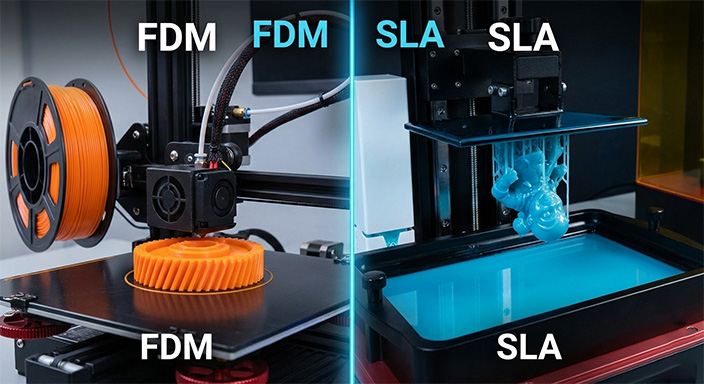
Fused Deposition Modeling (FDM) is the most common type of 3D printing. It works by melting a plastic string (filament) and “drawing” your object layer by layer.
The Pros:
- Affordability: Entry-level printers are budget-friendly, and filaments like PLA are the most cost-effective materials on the market.
- Durability: FDM uses real thermoplastics (like ABS or Nylon), making it the gold standard for functional parts, jigs, and fixtures.
- Ease of Use: It’s relatively clean and “plug-and-play” compared to resin printing.
- Large Build Volume: If you want to print a life-sized helmet or a large mechanical housing, FDM is your best bet.
The Cons:
- Visible Layer Lines: You’ll likely see “stair-stepping” on the surface, which might require sanding.
- Lower Precision: Not ideal for tiny, intricate details like small jewelry or fine miniatures.
🧪 SLA: The Precision Specialist
Stereolithography (SLA) uses a high-powered UV laser or an LCD screen to harden liquid resin into solid plastic.
The Pros:
- Stunning Detail: SLA can produce details thinner than a human hair.
- Smooth Surface Finish: Prints look injection-molded straight off the machine.
- Isotropic Strength: Because the layers bond chemically, the parts are equally strong in all directions.
- Specialty Resins: You can use “Castable” resins for jewelry making or “Biocompatible” resins for dental work.
The Cons:
- The “Mess” Factor: Dealing with liquid resin requires gloves, masks, and isopropyl alcohol (IPA) for washing.
- Post-Processing: Every print must be washed and “cured” under UV light to reach full strength.
- Smaller Size: Most affordable SLA printers have a smaller build area than their FDM counterparts.
📊 Comparison at a Glance (2026 Standards)
| Feature | FDM (Filament) | SLA (Resin) |
| Surface Quality | Visible layers (Rigid) | Smooth & Glassy |
| Best For | Functional prototypes, large parts | Jewelry, dental, miniatures |
| Material Cost | Low (~$20-$50/kg) | High (~$50-$150/L) |
| Common Materials | PLA, PETG, ABS, TPU | Standard, Tough, Castable Resin |
| Complexity | Beginner-friendly | Requires safety gear/ventilation |
🚀 2026 Trends: What’s New?
As we move through 2026, the gap between these two is narrowing thanks to a few breakthroughs:
- AI-Driven Optimization: New software now uses AI to predict where an FDM print might fail, allowing for “thinner” layers that rival SLA quality.
- Sustainability: We’re seeing a massive surge in Recycled PETG for FDM and Bio-based Resins for SLA, making 3D printing in Bangladesh more eco-friendly.
- High-Speed Printing: Modern FDM printers (like the Bambu Lab series) are now printing at speeds that were unthinkable just three years ago.
Which One Should You Choose?
Choose FDM if:
- You are a student or hobbyist on a budget.
- You need to build functional tools, car parts, or sturdy enclosures.
- You want a simple, “set-it-and-forget-it” workflow.
Choose SLA if:
- You are a jeweler or dentist requiring extreme precision.
- You are a miniature painter or artist.
- You need parts with a flawless, professional aesthetic for presentation.
Ready to start your next project?
Choosing between FDM and SLA is like choosing between a reliable pickup truck and a precision-tuned sports car. Both will get you to your destination, but the “road” you’re traveling on—and what you’re carrying—makes all the difference.
In the rapidly growing tech landscape of Bangladesh, where everyone from engineering students in BUET to jewelry designers in Old Dhaka is adopting 3D printing, picking the right tech can save you thousands of Taka and hours of frustration.
Let’s break down the ultimate face-off: FDM vs. SLA.
🛠️ FDM: The Versatile Workhorse
Fused Deposition Modeling (FDM) is the most common type of 3D printing. It works by melting a plastic string (filament) and “drawing” your object layer by layer.
The Pros:
- Affordability: Entry-level printers are budget-friendly, and filaments like PLA are the most cost-effective materials on the market.
- Durability: FDM uses real thermoplastics (like ABS or Nylon), making it the gold standard for functional parts, jigs, and fixtures.
- Ease of Use: It’s relatively clean and “plug-and-play” compared to resin printing.
- Large Build Volume: If you want to print a life-sized helmet or a large mechanical housing, FDM is your best bet.
The Cons:
- Visible Layer Lines: You’ll likely see “stair-stepping” on the surface, which might require sanding.
- Lower Precision: Not ideal for tiny, intricate details like small jewelry or fine miniatures.
🧪 SLA: The Precision Specialist
Stereolithography (SLA) uses a high-powered UV laser or an LCD screen to harden liquid resin into solid plastic.
The Pros:
- Stunning Detail: SLA can produce details thinner than a human hair.
- Smooth Surface Finish: Prints look injection-molded straight off the machine.
- Isotropic Strength: Because the layers bond chemically, the parts are equally strong in all directions.
- Specialty Resins: You can use “Castable” resins for jewelry making or “Biocompatible” resins for dental work.
The Cons:
- The “Mess” Factor: Dealing with liquid resin requires gloves, masks, and isopropyl alcohol (IPA) for washing.
- Post-Processing: Every print must be washed and “cured” under UV light to reach full strength.
- Smaller Size: Most affordable SLA printers have a smaller build area than their FDM counterparts.
📊 Comparison at a Glance (2026 Standards)
| Feature | FDM (Filament) | SLA (Resin) |
| Surface Quality | Visible layers (Rigid) | Smooth & Glassy |
| Best For | Functional prototypes, large parts | Jewelry, dental, miniatures |
| Material Cost | Low (~$20-$50/kg) | High (~$50-$150/L) |
| Common Materials | PLA, PETG, ABS, TPU | Standard, Tough, Castable Resin |
| Complexity | Beginner-friendly | Requires safety gear/ventilation |
🚀 2026 Trends: What’s New?
As we move through 2026, the gap between these two is narrowing thanks to a few breakthroughs:
- AI-Driven Optimization: New software now uses AI to predict where an FDM print might fail, allowing for “thinner” layers that rival SLA quality.
- Sustainability: We’re seeing a massive surge in Recycled PETG for FDM and Bio-based Resins for SLA, making 3D printing in Bangladesh more eco-friendly.
- High-Speed Printing: Modern FDM printers (like the Bambu Lab series) are now printing at speeds that were unthinkable just three years ago.
Which One Should You Choose?
Choose FDM if:
- You are a student or hobbyist on a budget.
- You need to build functional tools, car parts, or sturdy enclosures.
- You want a simple, “set-it-and-forget-it” workflow.
Choose SLA if:
- You are a jeweler or dentist requiring extreme precision.
- You are a miniature painter or artist.
- You need parts with a flawless, professional aesthetic for presentation.
Ready to start your next project?
Choosing the right tech is the first step toward a successful build. If you’re still unsure which one fits your specific design, we can help you decide based on your CAD file.