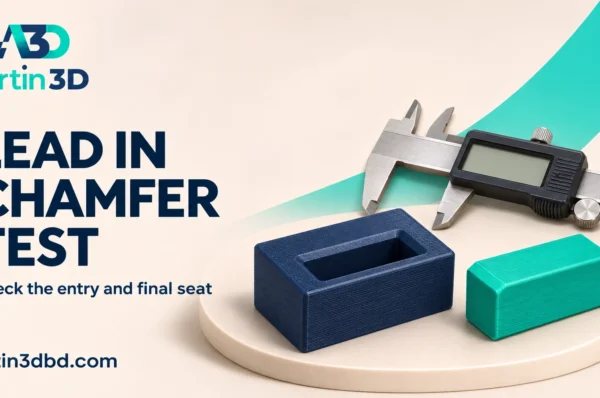
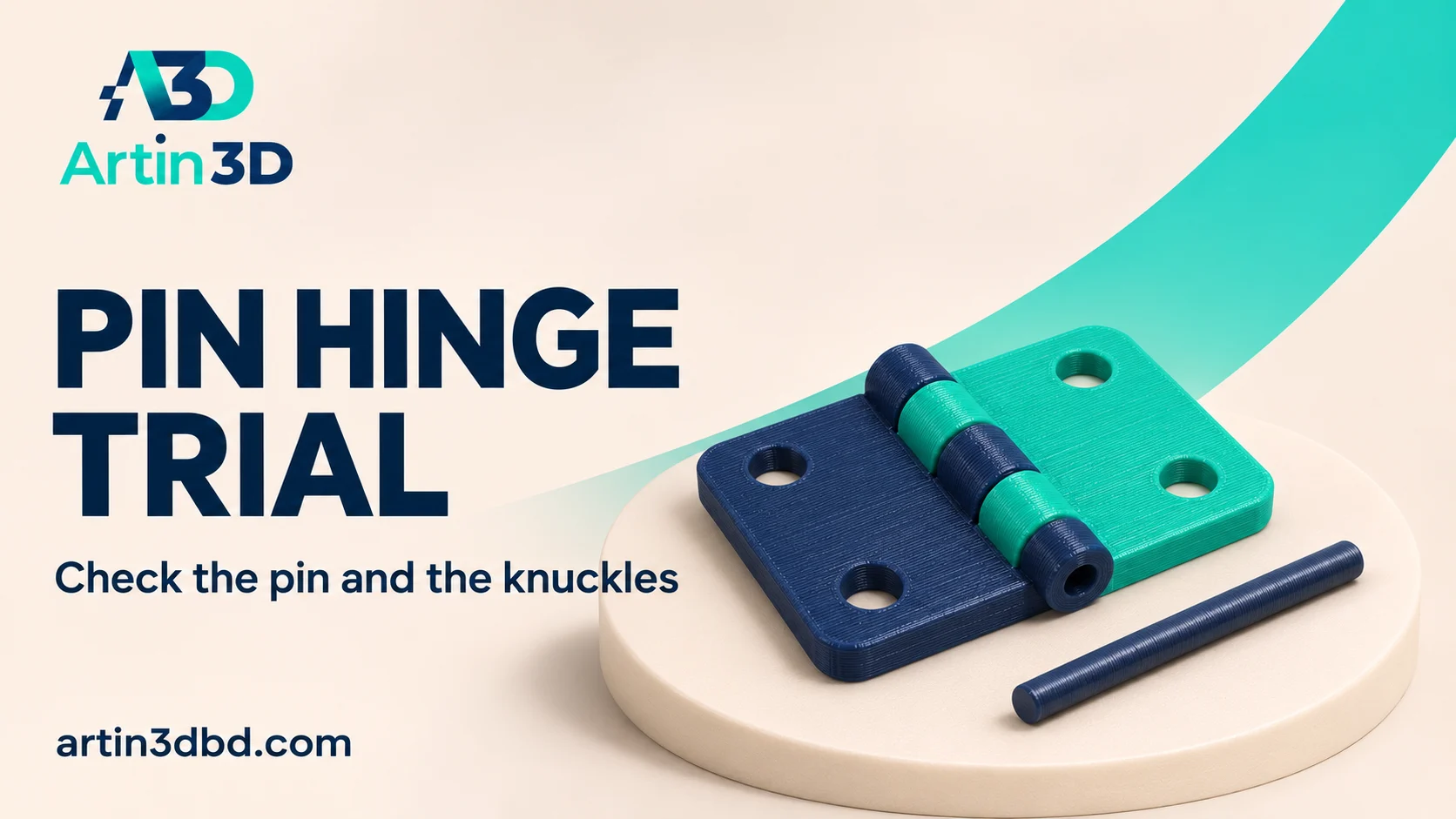
Full hinged lid এর আগে pin ও knuckle এর short sample বানান। Pin ঢোকানোর route, rotation ও side play একসঙ্গে দেখুন।
A hinged lid depends on more than a pin passing through one hole. The knuckles must align, clear each other during rotation and remain accessible for assembly. A short hinge coupon makes those relationships easier to inspect before the complete lid is printed. This guide describes a low risk prototype with a separate pin installed after printing, using a representative material and orientation.
Define the pin and the intended motion
Record the actual pin specification and whether it is printed or purchased hardware. Identify the hinge axis, the desired range of rotation and the method used to retain the pin. Include the space required to insert it from one end. Keep the original lid and frame reference faces visible in the design. A pin route that works for a loose coupon may be blocked by the complete enclosure wall.
Separate pin diameter from hole size using Check Hole Compensation With a Separate Pin and Hole Coupon.
Preserve the real knuckle arrangement
Build a short sample with the intended alternating knuckles, bore geometry and side gaps. Retain enough surrounding material to represent the root of each knuckle. Prusa’s modeling guidance emphasizes that moving assemblies need allowances suited to the geometry, orientation and material. Record those dimensions explicitly. Avoid assuming one universal clearance or a convenient scaled hinge sample represents the final size accurately.
Inspect the bore and gaps through the slice
Use the actual print orientations and supported printer profile. Examine where bore roofs, first layer edges or supports intersect the moving surfaces. Save views of the smallest gaps and the pin entry. Confirm that the paths preserve distinct knuckles where separation is required. Keep the baseline project and note any cleanup expected before assembly so the fit trial can be reproduced.
Insert the pin and rotate the cooled sample
After cooling, photograph the unmodified parts and inspect the pin route. Assemble gently without forcing a misaligned bore. Rotate through the intended range while checking contact between knuckles and surrounding faces. Record resistance at the start, middle and end of travel, along with side play and the condition of the roots. A few smooth hand movements do not establish a repeated use life or load rating.
Revise one interference or alignment feature
Determine whether the problem lies in bore size, alignment, side clearance, pin condition or a local printed edge. Change one relevant design parameter or documented cleanup step and repeat the short sample. Keep the material and orientation identified. If the hinge is loose, record where the movement occurs instead of shrinking every gap indiscriminately. Evaluate retention separately from the ease of rotation.
Approve the complete lid assembly route
Save the accepted hinge and pin record with photographs showing the useful range of motion. Check the complete lid and enclosure for pin access, stops and nearby obstacles before the larger print. Include the intended application and any required further testing. Recheck the hinge when the material, nozzle or surrounding geometry changes, because those changes can affect both assembly and motion.
Before the full lid, verify reference geometry with Check a Bracket Angle and Hole Spacing Before Slicing.
Relevant products from Artin3D
SUNLU PETG Filament 1.75mm
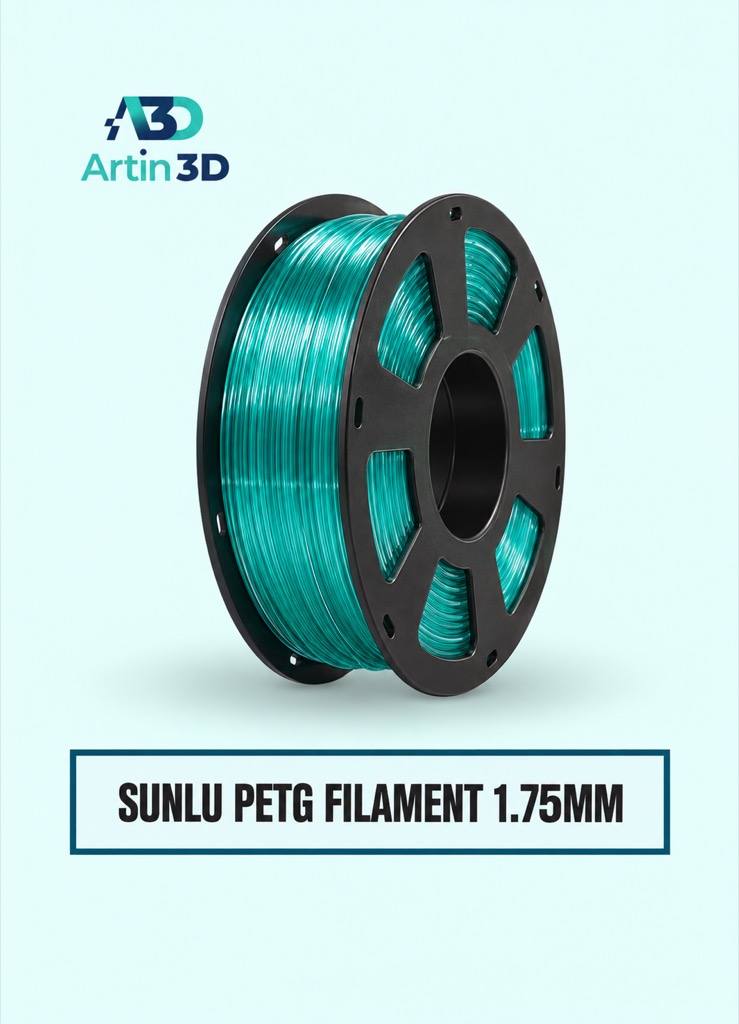
SUNLU PETG can be evaluated for a compatible PETG hinge prototype. Confirm the grade and assess the actual motion and use requirements.
Digital Vernier Caliper
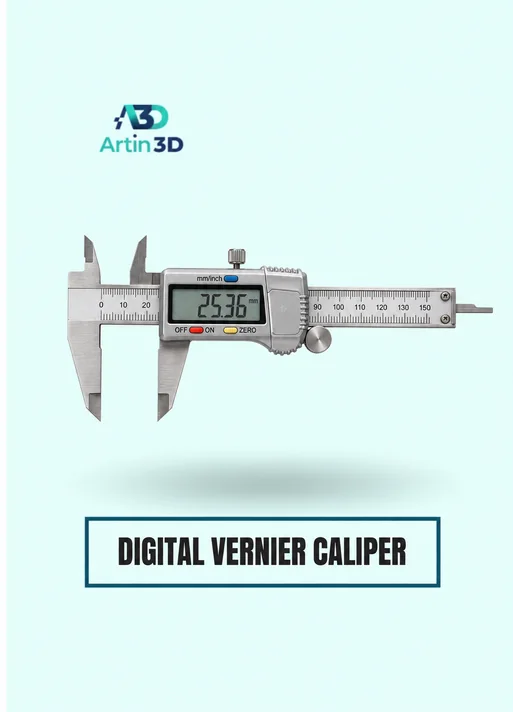
The Digital Vernier Caliper helps check accessible pin and knuckle dimensions. Small internal bores may need another inspection method in addition to the assembly trial.
Quick questions
Does fitting the pin prove the hinge works?
Check alignment, rotation, side play, retention and the complete assembly route too.
Can I approve repeated use after a few hand movements?
That only records the observed trial. Required durability and loading need suitable validation.
Confirm the exact product variant, printer compatibility, current price and availability on the linked product page before ordering.
Need help preparing a representative sample? Explore Artin3D’s 3D design service or upload your STL file for a 3D printing quote. Include the mating part dimensions, intended material and assembly requirements.